
Disclosure: This guide contains one affiliate link and a discount code. If you buy through them, She Chooses Well may earn a commission at no extra cost to you. Prices were checked on the Passion 4 Health store on 13 November 2026 and are in USD (the store ships to US customers only). This article is general information, not medical advice.
If you have ever stood in front of a supplement shelf holding a multivitamin the size of a vitamin-shaped horse pill, you already understand why liquid vitamins exist. They promise no swallowing, “better absorption” and a single daily shot instead of a handful of tablets. They also tend to cost more, need refrigerating, and taste like… well, vitamins.
So which is actually better? The short answer is that for most healthy adults, a well-made pill and a well-made liquid deliver similar nutrition, and the right choice depends far more on what you will take consistently, what is in the formula, and how much you are paying. This guide walks through the real differences, the absorption claims, the nutrients worth double-checking on any label, and who genuinely benefits from switching to a liquid.
Do you need a multivitamin at all?
Start here, because it changes everything else. According to the NIH Office of Dietary Supplements, most people can get the nutrients they need from a varied diet, and multivitamins are not a substitute for one. That said, multivitamins can help fill real gaps, and some groups are more likely to have them:
- People who eat very little or very selectively, including during illness, recovery or periods of low appetite.
- Vegans and many vegetarians, who need a reliable source of vitamin B12.
- Women who could become pregnant, who are advised to get folic acid daily.
- Older adults, who absorb B12 less efficiently and often need more vitamin D.
- Anyone with limited sun exposure, for vitamin D.
If you fit one of those, a daily multivitamin is a reasonable insurance policy. If you eat well and have no specific gaps, the benefit is likely to be small, whichever format you choose.
Liquid vs pill: the honest comparison
| Liquid multivitamin | Tablet or capsule | |
|---|---|---|
| Easy to take | Excellent for anyone who struggles to swallow pills. Can be mixed into juice or a smoothie. | Can be large. Capsules and smaller split doses help. |
| Absorption | Already dissolved, so no breakdown step. Real-world advantage for most nutrients in healthy people is not well proven. | Good-quality tablets disintegrate properly in the gut. Look for a USP Verified mark, which includes a disintegration test. |
| Dose flexibility | Easy to adjust (for example, smaller servings for children, if the label allows). | Fixed dose per tablet. |
| Stability and storage | Some nutrients are less stable in liquid. Many need refrigerating after opening and have a shorter use-by window. | More shelf-stable. Store dry and cool. |
| Taste | Varies a lot. Minerals and B vitamins can taste strong. | Mostly neutral, aside from the occasional vitamin burp. |
| Cost | Usually higher per day. | Usually cheaper, especially store brands. |
| Travel | Bulky and liquid-restricted on flights. | Easy to pack. |
The absorption question, without the marketing
“Up to 98% absorption” type claims are common on liquid vitamins. They usually compare a liquid to a poorly made tablet that does not break down properly. That is a real problem with some cheap tablets, which is why independent standards such as USP’s disintegration testing exist. Against a tablet that does disintegrate properly, the evidence that liquids are meaningfully better absorbed for most vitamins and minerals in healthy people is limited.
Where format genuinely matters:
- Fat-soluble vitamins (A, D, E, K) are absorbed better with some fat. A liquid or softgel that includes an oil, or taking any supplement with a meal containing fat, helps.
- People with absorption issues, such as after some types of bariatric surgery or with certain gut conditions, may do better with liquid or chewable formats. This is a conversation to have with your doctor or dietitian, who may recommend specific forms and doses.
- Consistency. The most bioavailable vitamin in the world does nothing in the cupboard. If a liquid means you take it every day and a pill means you do not, that is a real advantage.
Five things to check on any multivitamin label
- Vitamin D amount. The recommended intake for adults is 600 IU (15 mcg) a day up to age 70, and 800 IU after that. The tolerable upper intake level, the most you should take daily without medical supervision, is 4,000 IU (100 mcg). Some products, including single-nutrient D3 supplements, go above that.
- Vitamin K. Vitamin K, including K2, can interact with blood thinners such as warfarin. If you take one, speak to your doctor before starting any product containing it.
- Biotin. High-dose biotin, common in hair, skin and nail formulas, can interfere with some lab tests, including thyroid and heart tests. The FDA has warned about this. Tell your doctor before any blood work.
- Folate form and B12. Methylated forms (methylfolate and methylcobalamin) are increasingly common. They are a reasonable choice, although standard folic acid and cyanocobalamin are also well studied.
- Third-party testing. Supplements are not approved by the FDA before sale. Look for independent testing (USP, NSF, Clean Label Project or published certificates of analysis) for purity and contaminants such as heavy metals.
Who should consider a liquid multivitamin
- You have trouble swallowing tablets, or you have tried pills and keep stopping.
- Your appetite is low and you want something easy to take alongside small meals.
- You already have a daily smoothie or juice to mix it into.
- You want one product for several family members of different ages (only where the label gives a dose for each age).
Stick with a pill if price is your priority, you travel a lot, or you dislike strong flavours. If you are also weighing a greens powder against a multivitamin, our greens powder vs multivitamin comparison explains what each one actually covers.
A closer look at Passion 4 Health
Passion 4 Health is a family-owned US brand (since 2007) that makes only liquid supplements. Its core product is the Daily Liquid Multivitamin + Minerals, a one-ounce daily shot built on an aloe vera base. The brand supports Passion 4 K.I.D.S., a 501(c)(3) nonprofit helping US children, founded by the company’s founder.
The product range
| Product | Key points (per Passion 4 Health) | Price (13 Nov 2026) |
|---|---|---|
| Daily Liquid Multivitamin + Minerals | “Over 100” nutrients: vitamins, full B-complex with methylated B12 and L-methylfolate, 72 ionic trace minerals from red algae (Lithothamnion), amino acids. Aloe vera base. Vegan, gluten-free, caffeine-free. 1 oz daily. Ages 8+ (check label for children’s dose). Refrigerate after opening. | $45.95 one-time (regular $49.95). Subscribe: $39.06 monthly, or $34.46 per bottle on a 3-bottle, 3-month plan. |
| D3, K2 & Omega-3 Daily Liquid | Per 1 mL: 125 mcg (5,000 IU) vitamin D3, 120 mcg vitamin K2 (MK-7), 250 mg plant omega-3 (ALA) from flaxseed oil. 30 servings. Adults 18+. | $19.99 (regular $24.95); $14.99 per bottle on a 3-month subscription. |
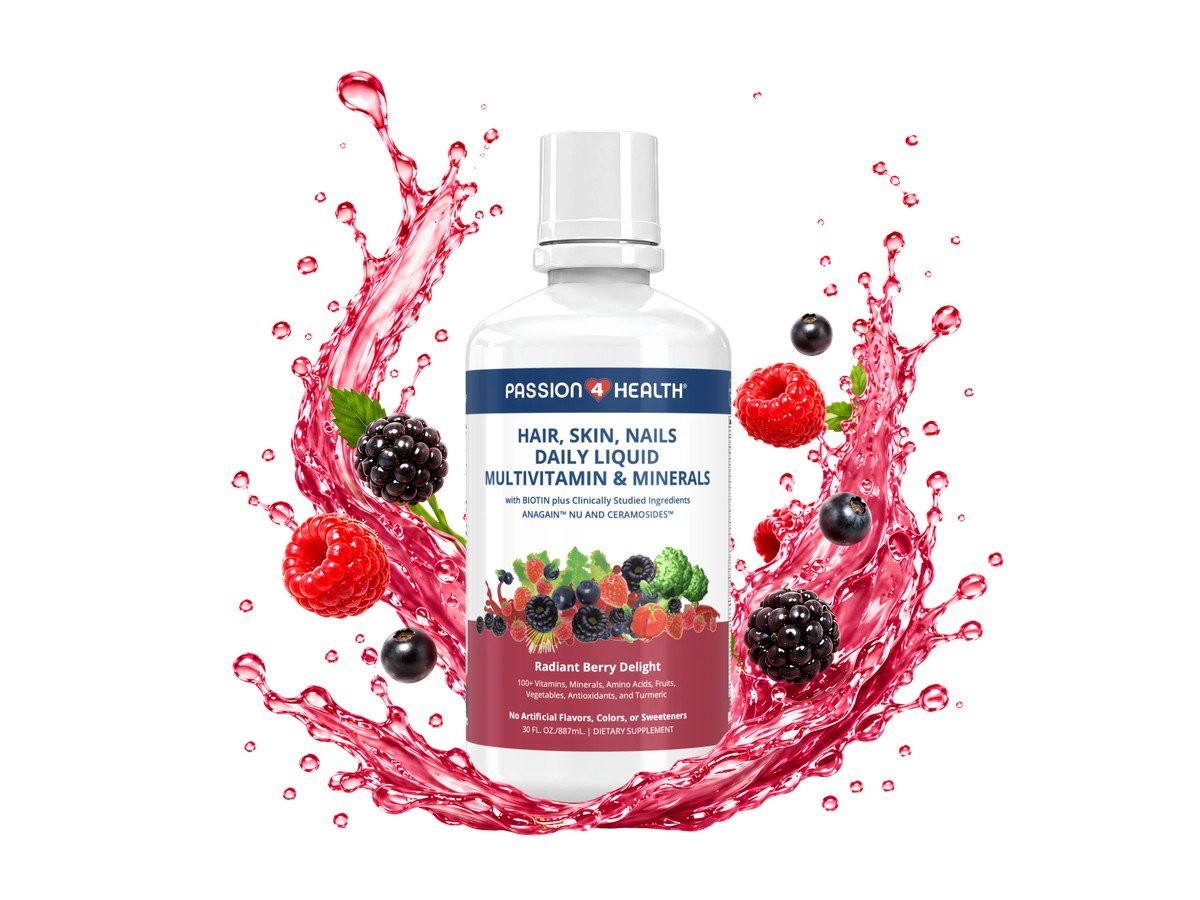
| Hair, Skin & Nails Liquid Multivitamin | The multivitamin base plus AnaGain™ Nu (pea shoot extract), Ceramosides™ (wheat extract, gluten-free) and 10,000 mcg biotin. Adults 18+. | $69.95 |
| Daily Liquid Eye Care | MaquiBright® (maqui berry extract), taurine, grape extract, vitamins C and E, zinc. Adults 18+. | $44.97 |
| Wellness Pack | Multivitamin + Eye Care + D3/K2/Omega-3. | $89.85 |
What stands out
- Independent purity testing. The multivitamin holds a Clean Label Project Purity Award, which the brand says involved testing for over 200 environmental contaminants, including heavy metals and pesticides. That is more meaningful than “lab tested” with no detail.
- Genuinely pill-free. If tablets are the reason you have never stuck with a multivitamin, a single one-ounce shot removes that barrier.
- Allergen-friendly. Made without dairy, eggs, shellfish, tree nuts, peanuts, wheat, sesame or artificial colours.
- Strong customer ratings, with a caveat. The multivitamin shows 4.9 stars from about 990 reviews on the brand’s own site (checked 13 November 2026). These are hosted by the brand, so they are not fully independent. Common praise is taste and ease; a few reviews mention thicker consistency in some shipments and slow delivery.
- HSA/FSA option. The store offers HSA/FSA payment through Truemed.
What to weigh up
- The D3/K2/Omega-3 dose is high. 5,000 IU of vitamin D a day is above the 4,000 IU upper limit for adults. It may be appropriate if your doctor has found you are low in vitamin D and recommends a higher dose, but it is not something to add on top of a multivitamin and other D sources without checking. The K2 means anyone on blood thinners must speak to their doctor first, which the brand also states.
- The plant omega-3 is ALA. 250 mg of ALA from flax is a modest amount (adult women are advised to get about 1.1 g of ALA a day from all sources), and it is not the same as the EPA and DHA in fish or algae oil.
- Biotin in the Hair, Skin & Nails formula. 10,000 mcg is a high dose. Tell your doctor you take it before any blood test.
- The ingredient amounts are in an image. The full Supplement Facts for the multivitamin are shown as a label image on the product page. Read it before buying, especially if you take other supplements.
- Strict return policy. Refunds or replacements apply only to unused products within 30 days of the invoice, minus shipping costs and a $10-per-bottle handling fee. Opened bottles cannot be returned.
- Subscription cancellation timing. Changes must be made at least 48 hours before an order is processed, and not over weekends. Set a reminder if you subscribe.
- US only. The store is directed only at US customers.
Who Passion 4 Health suits
It is a strong option if you want a pill-free daily multivitamin with independent contaminant testing, and you are happy to keep a bottle in the fridge. Start with the core Daily Liquid Multivitamin rather than the bundle. Only add the D3/K2/Omega-3 if a doctor has advised extra vitamin D. If you also train regularly, our guide to creatine for women covers the other supplement most worth considering.
How to buy Passion 4 Health and save
- Use the code DAILY10 at checkout for 10% off.
- Try one bottle first. Taste is personal with liquid vitamins, and opened bottles cannot be returned. Buy a single bottle with DAILY10 before committing to a subscription.
- Then compare subscription pricing. If you like it, the 3-bottle plan brings the multivitamin down to $34.46 a bottle. Check whether DAILY10 applies to subscription orders at checkout.
- Look out for seasonal offers. At the time of checking, the store was advertising a Black Friday “Buy 2, Get 1 Free” offer. Compare that against DAILY10 to see which gives the lower total.
Type DAILY10 into the discount box before paying and confirm the 10% is applied in the order summary.
Shop Passion 4 Health – code DAILY10 for 10% off
Sources
- NIH Office of Dietary Supplements. Multivitamin/mineral Supplements: Fact Sheet for Health Professionals.
- NIH Office of Dietary Supplements. Vitamin D: Fact Sheet for Health Professionals.
- NIH Office of Dietary Supplements. Vitamin K: Fact Sheet for Health Professionals.
- NIH Office of Dietary Supplements. Omega-3 Fatty Acids: Fact Sheet for Health Professionals.
- US Food and Drug Administration. Safety communication: biotin (vitamin B7) can interfere with lab tests.
- United States Pharmacopeia. USP Dietary Supplement Verification Program.
- Passion 4 Health product pages, refund, shipping and subscription policies (passion4healthvitamins.com), checked 13 November 2026.