

Disclosure: This guide contains one affiliate link. If you buy through it, She Chooses Well may earn a commission at no extra cost to you. This article is general information, not medical advice. Prices were checked on the Broc Shot store on 13 November 2026 and are shown in approximate USD.
Sulforaphane has become one of the most talked-about compounds in wellness, mostly thanks to long-form podcasts and longevity researchers. It’s now showing up in powders and capsules marketed for everything from detox to clearer, calmer skin. The underlying science is genuinely interesting, but it’s also easy to overstate.
This guide explains what sulforaphane is, why broccoli sprouts are the richest food source, what the research does and doesn’t show (including for skin), how to get it from food, what to look for in a supplement, and who should be cautious.
What sulforaphane actually is
Sulforaphane isn’t sitting ready-made inside broccoli. The plant stores an inactive precursor called glucoraphanin, plus an enzyme called myrosinase, in separate compartments. When the plant is chopped, chewed or blended with water, the two meet, and myrosinase converts glucoraphanin into sulforaphane. It’s a defence system: the reaction happens when an insect bites the plant.
That chemistry explains almost everything about getting sulforaphane in practice:
- No myrosinase, little sulforaphane. Cooking broccoli thoroughly destroys myrosinase, so much less sulforaphane forms (some is still produced by gut bacteria, but far less reliably).
- Water and time matter. The conversion needs moisture and a few minutes.
- The precursor amount varies hugely by plant, variety and age.
Why broccoli sprouts, not just broccoli
Young broccoli sprouts, just a few days old, contain far more glucoraphanin per gram than mature broccoli heads. Researchers at Johns Hopkins reported in the 1990s that three-day-old sprouts can contain many times the glucoraphanin of mature broccoli, which is why sprouts and broccoli seed powders became the focus of research and supplements. You’d need to eat an impractical amount of mature broccoli to match what a small serving of sprouts provides.
What the research shows, and where it stops
The well-established part
Sulforaphane is one of the most studied activators of a cellular pathway called Nrf2, which switches on the body’s own antioxidant and detoxification enzymes. This is well documented in laboratory and animal research, and there are human studies showing that broccoli sprout preparations can raise markers of these enzymes and increase the excretion of certain environmental pollutants.
The promising but early part
Human trials have explored sulforaphane for areas such as blood sugar control, inflammation and some neurological conditions. Many are small or short, and results are mixed. They’re reasons for further research, not proof that a daily supplement will change those outcomes for you.
And for skin?
Skin is where much of the current marketing is focused. The most direct evidence comes from small studies of topical broccoli sprout extract applied to the skin, which reduced redness from UV exposure in volunteers. Evidence that oral sulforaphane visibly improves skin, such as clarity, redness or signs of ageing, is much thinner and mostly comes from small or brand-sponsored studies. It’s plausible that reducing oxidative stress could help skin, but “plausible” isn’t the same as “proven”.
A fair summary: sulforaphane is a well-researched compound with a strong biological rationale, early human data in several areas, and limited independent evidence for visible skin results so far.
Getting sulforaphane from food
| Method | How | Pros | Cons |
|---|---|---|---|
| Grow your own sprouts | Soak broccoli seeds, rinse twice daily, harvest after about 3–5 days | Cheapest per serving; fresh | Takes daily attention; sprouts carry a food-safety risk if not grown hygienically |
| Buy fresh sprouts | Eat raw in salads or sandwiches, chewed well | No effort | Hard to find; short shelf life; same food-safety caution |
| Chop and wait | Chop raw broccoli and let it sit 30–40 minutes before lightly cooking | Uses ordinary broccoli | Much lower amounts than sprouts |
| Add mustard seed | Sprinkle mustard powder on cooked broccoli | Mustard contains myrosinase, which can restore some conversion | Modest effect; a nice kitchen trick rather than a dose |
Raw sprouts have been linked to foodborne illness outbreaks because the warm, humid conditions that sprout seeds also suit bacteria. People who are pregnant, elderly or immunocompromised are generally advised to avoid raw sprouts.
How much sulforaphane is “enough”?
There’s no official recommended intake for sulforaphane, because it isn’t an essential nutrient. Human studies have used a wide range of doses, often expressed as micromoles of glucoraphanin or sulforaphane, and the amount that actually reaches your bloodstream depends on the product, the enzyme activity and your own gut. That’s why two products with the same “broccoli sprout” label can deliver very different amounts.
In practical terms, consistency probably matters more than chasing a high dose. If you try a supplement, take it the way the brand recommends, at the same time each day, for long enough to judge (most brands suggest at least four weeks). Don’t stack multiple sulforaphane products, and remember that food sources still count: a handful of fresh sprouts a few times a week is a perfectly reasonable approach.
Five myths about sulforaphane
- “It detoxes your body.” Your liver and kidneys detoxify you. Sulforaphane may support some of the enzymes involved, but it isn’t a cleanse.
- “Cooked broccoli gives you the same benefit.” Thorough cooking greatly reduces sulforaphane formation. Light steaming for a few minutes preserves more than boiling.
- “More is always better.” Higher doses raise the chance of stomach upset and haven’t been shown to give proportionally bigger benefits.
- “It works like a skincare active overnight.” Any effect from an oral supplement would be gradual and subtle. Judge it over weeks, not days.
- “Any broccoli supplement contains sulforaphane.” Many contain only the precursor, and some contain very little of either. Read the label.
Where sulforaphane fits in a skin routine
If your main goal is better skin, the basics still do most of the work: daily sunscreen, a gentle cleanser, a moisturiser suited to your skin type, and a proven active such as a retinoid, vitamin C or azelaic acid where appropriate. Sleep, stress and diet matter too. A sulforaphane supplement, if you choose one, is best seen as an extra layer on top of that foundation, not a replacement for it. If you have persistent acne, rosacea or sudden skin changes, a dermatologist will be far more useful than any supplement.
What to look for in a sulforaphane supplement
Supplements vary more than almost any other category, because “broccoli extract” can mean very different things:
- Does it contain active myrosinase, or stabilised sulforaphane? Glucoraphanin alone, without the enzyme, relies on your gut bacteria and converts poorly for many people.
- Is the dose stated? Look for an amount of glucoraphanin, sulforaphane or “sulforaphane yield” per serving, not just “broccoli sprout powder 500 mg”.
- Whole seed or sprout powder vs extract. Whole powders include the natural enzyme but can taste strong. Extracts are more concentrated but vary in how much enzyme survives processing.
- How do you take it? Some powders are designed to be mixed with water and left briefly, to let the conversion happen before you drink.
- Third-party testing and a clear money-back guarantee are useful signs of quality and confidence.
Growing broccoli sprouts at home, safely
If you’d rather try the food route, home sprouting is simple. Buy seeds sold specifically for sprouting (they’re tested for pathogens), soak about two tablespoons in a clean jar overnight, drain, then rinse with clean water twice a day, keeping the jar tilted so excess water drains. After three to five days, when small green leaves appear, rinse well and refrigerate. Use clean equipment every time, discard anything that smells off or looks slimy, and eat them within a few days. Chew them thoroughly, which is what triggers the enzyme reaction.
Who should be cautious
- Pregnant or breastfeeding: there isn’t enough safety data on supplemental doses. Food amounts of cooked broccoli are fine; check with your doctor before supplements.
- People on medication: sulforaphane affects enzymes involved in processing some drugs. Ask your pharmacist or doctor if you take regular medication.
- Thyroid conditions: very large intakes of cruciferous compounds have theoretical effects on thyroid function, mainly in people with low iodine. If you have a thyroid condition, discuss it with your doctor.
- Sensitive stomachs: the most common side effects reported are gas, bloating and stomach upset, especially at first. Starting with a smaller serving can help.
A closer look: Broc Shot
Broc Shot is a US brand selling a daily sulforaphane product made from what it describes as gently milled whole broccoli seed powder. It’s designed around the chemistry above: Broc Shot tells customers to mix the powder with about 2 oz (60 ml) of water and drink it within 15 minutes, so that the glucoraphanin and myrosinase in the whole seed have water to react in. It’s also available as capsules.
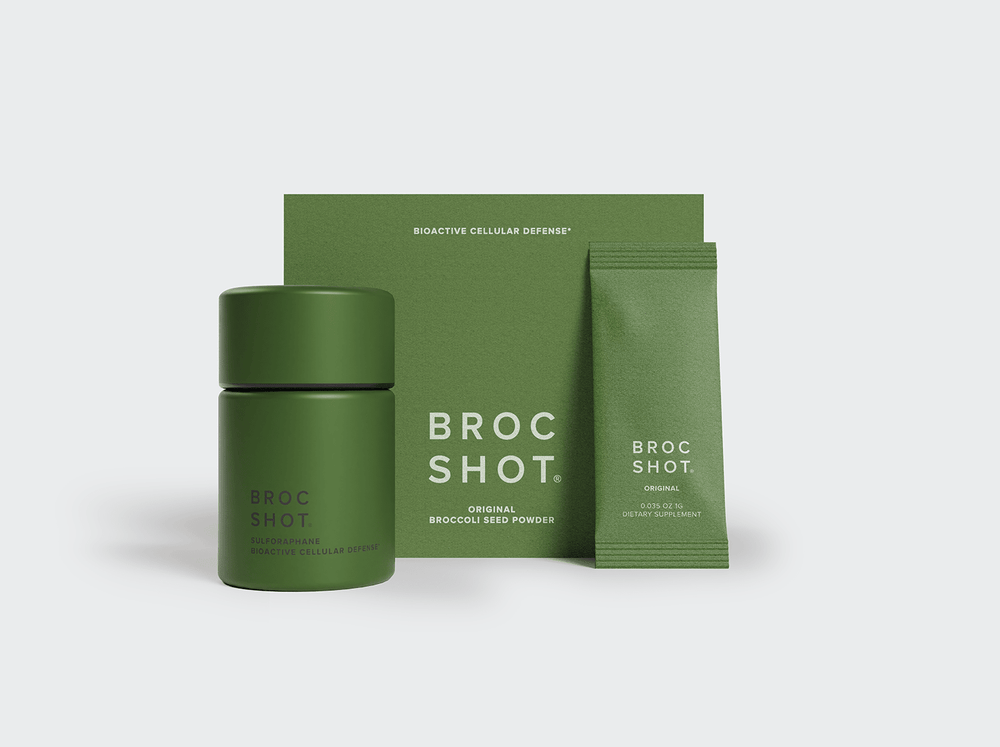
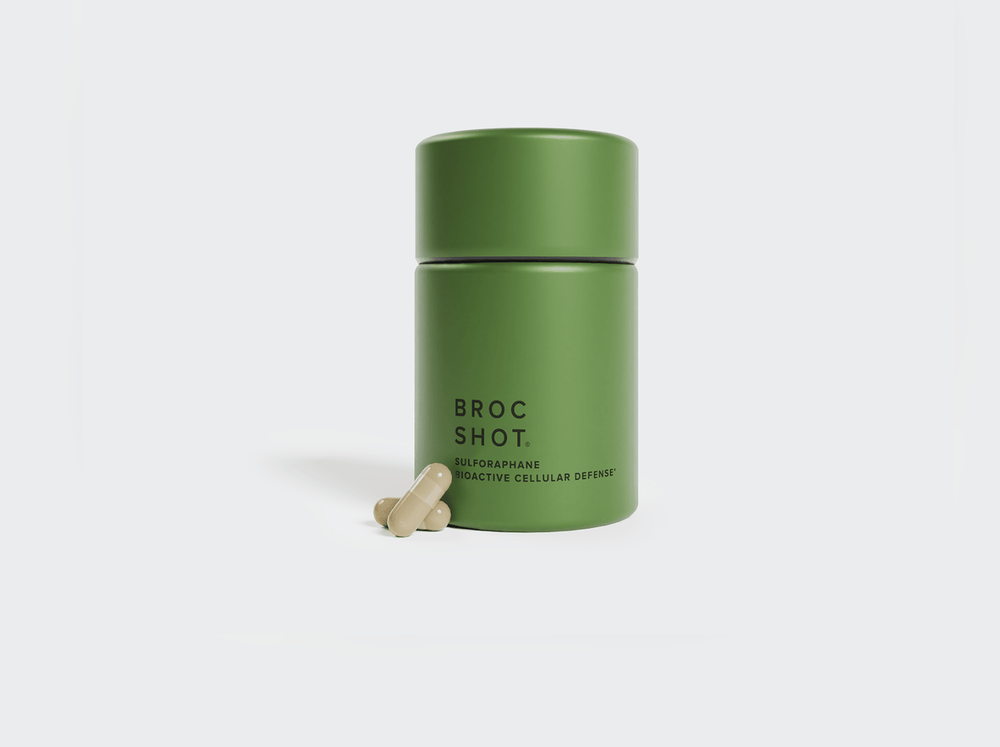
Images: Broc Shot
How it’s positioned
Broc Shot currently markets the product mainly for skin, with benefits it describes as more luminous, clearer and younger-looking skin, aimed at people with sensitive skin, signs of ageing, hormonal changes or breakout-prone skin. The brand cites a consumer perception study by Essex Testing Clinic with 50 participants aged 18–70 after four weeks, in which 98% said their skin looked more luminous, 96% clearer and 86% younger-looking.
It’s worth reading that carefully: a perception study measures how users felt their skin looked, it’s commissioned by the brand, and it has no placebo group. That doesn’t make it worthless, but it isn’t the same as a controlled clinical trial, and individual results will vary. Broc Shot itself notes that results vary.
| Checklist item | Broc Shot |
|---|---|
| Enzyme present? | Whole broccoli seed powder, which naturally contains myrosinase; mixed with water before drinking |
| Formats | Powder (Original, Ginger + Lime, Pineapple + Mint) or capsules |
| Serving options | 30 or 60 servings |
| Guarantee | 30-day money-back guarantee, per Broc Shot |
| Evidence for skin claims | Brand-commissioned consumer perception study (see above) |
Price
When we checked, a 30-serving pouch with a shaker was listed at about US$80 as a one-off purchase and about US$70 on subscription, with refills and a capsule option at similar price points. That works out to roughly $2.30–$2.70 per serving before any discount. Broc Shot says orders ship the same business day, with standard US delivery in 2–7 business days.
Who it suits
- Good fit: someone who wants a convenient daily sulforaphane source, doesn’t want to grow sprouts, and is happy to treat any skin improvement as a possible bonus rather than a guarantee.
- Think twice: if you’re pregnant or breastfeeding, take regular medication or have a thyroid condition (check with your doctor first), or if budget is tight, since home-grown sprouts are much cheaper.
How to buy and save on Broc Shot
- Use our link: Broc Shot applies a 20% discount when you order through our partner link below, with no code needed.
- Use the 30-day guarantee: give it the full month, as recommended, before deciding whether it’s worth continuing.
- Take photos: if you’re trying it for skin, photograph your face in the same light on day one and day 30. It’s the only fair way to judge.
Try Broc Shot – 20% off through this link
Sources (checked 13 November 2026): Broc Shot product pages, preparation instructions, consumer perception study summary, pricing and shipping policy (brocshot.com). Background on glucoraphanin, myrosinase, broccoli sprout content and Nrf2 activation reflects published research from Johns Hopkins University researchers and subsequent human studies, including small trials of topical broccoli sprout extract and UV-induced skin redness. Food-safety guidance on raw sprouts reflects public health advice from food safety authorities.