

Disclosure: This guide contains one affiliate link and a discount code. If you buy through them, She Chooses Well may earn a commission at no extra cost to you. Prices were checked on Romalar’s store on 13 November 2026 and are in USD.
A decade ago, choosing an engagement ring stone meant choosing a natural diamond, then deciding how much you could stretch. Today, two alternatives have gone mainstream: lab-grown diamonds, which are real diamonds made in a factory, and moissanite, a different gemstone that looks very similar to diamond at a fraction of the price. Both are popular for engagement rings, wedding sets and everyday rings you’d never risk with a mined diamond.
The right choice depends on what you value: price, sparkle style, durability, resale, or simply the word “diamond”. This guide compares them on the things that actually matter, explains how to read the specs on a product page, and covers what to check before ordering a made-to-order ring online.
The quick comparison
| Moissanite | Lab-grown diamond | Natural diamond | |
|---|---|---|---|
| What it is | Silicon carbide; a different mineral | Carbon; chemically identical to diamond | Carbon, formed in the earth |
| Hardness (Mohs) | About 9.25 | 10 | 10 |
| Sparkle | More “fire” (rainbow flashes) | Classic diamond brilliance | Classic diamond brilliance |
| Relative price | Lowest | Middle | Highest |
| Grading | Less standardised | Graded by major labs (e.g. IGI, GIA) | Graded by major labs |
| Resale value | Low | Low and falling | Partial; well below retail |
What moissanite is, and why it sparkles differently
Moissanite is silicon carbide. It was first found in a meteorite crater, but natural moissanite is so rare that all jewellery moissanite is lab-created. It’s a genuine gemstone in its own right, not a diamond imitation like cubic zirconia.
Optically, moissanite bends light more strongly than diamond (a higher refractive index) and splits it into colours more strongly (higher dispersion). In plain terms: it throws more rainbow-coloured flashes, often called “fire”. Some people love that extra colour; others find it looks less like a diamond, especially in larger stones and bright sunlight. Under most everyday lighting, few people can tell the difference at a glance.
At about 9.25 on the Mohs hardness scale, moissanite is harder than every other popular gemstone except diamond, which makes it a practical choice for a ring worn every day. It won’t scratch or cloud with normal wear.
What lab-grown diamonds are
Lab-grown diamonds are made of carbon in the same crystal structure as mined diamonds, grown using high pressure and heat (HPHT) or chemical vapour deposition (CVD). They have the same hardness, the same optical properties and can only be distinguished from natural diamonds with specialist equipment. Major grading laboratories issue reports for them using the same cut, colour, clarity and carat scale.
Lab-diamond prices have fallen sharply over the past several years as production has scaled up. That’s great for buyers today, but it also means resale value is very low. If you’re buying a lab diamond, buy it to wear, not as an investment.
Price: the real difference
Comparing the same design is the clearest way to see the gap. At Romalar, a princess-cut half-eternity halo ring with a 6 × 6 mm centre stone (listed at 1.2 ct, VS clarity) and 40 small side stones is sold in both versions:
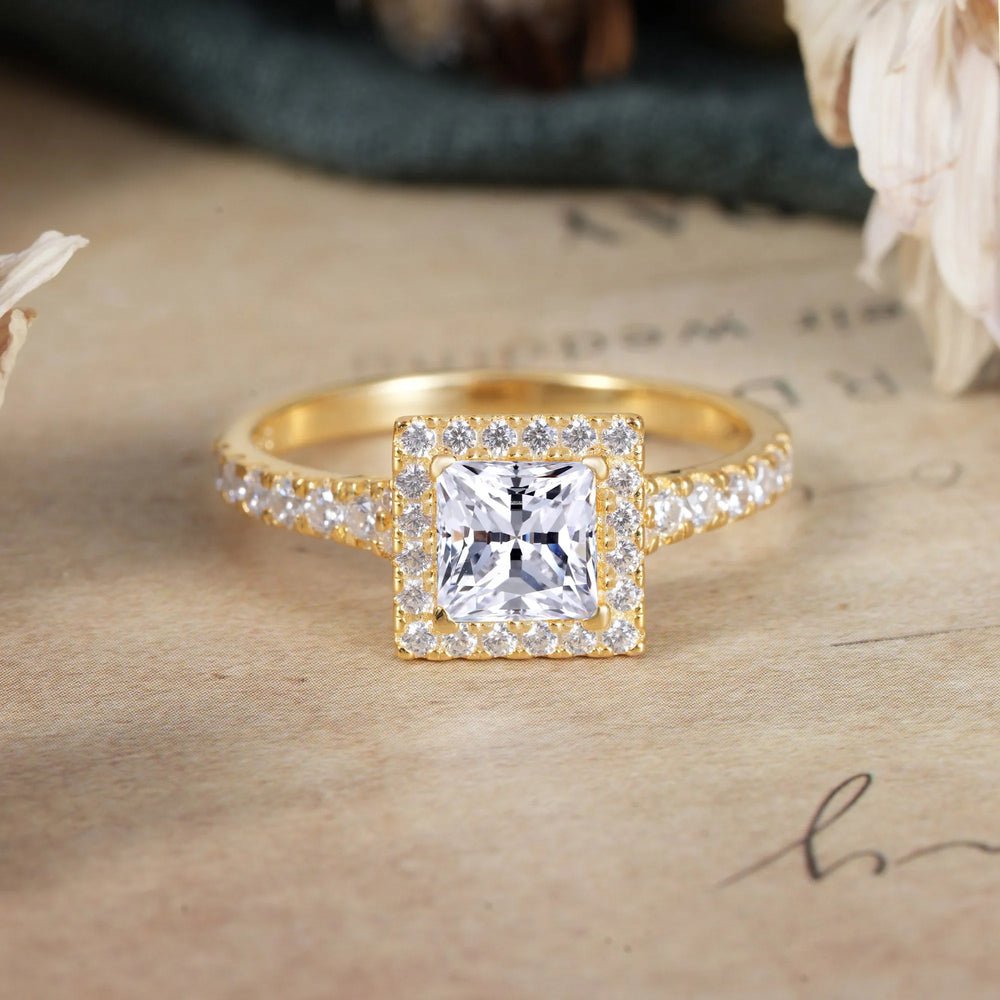
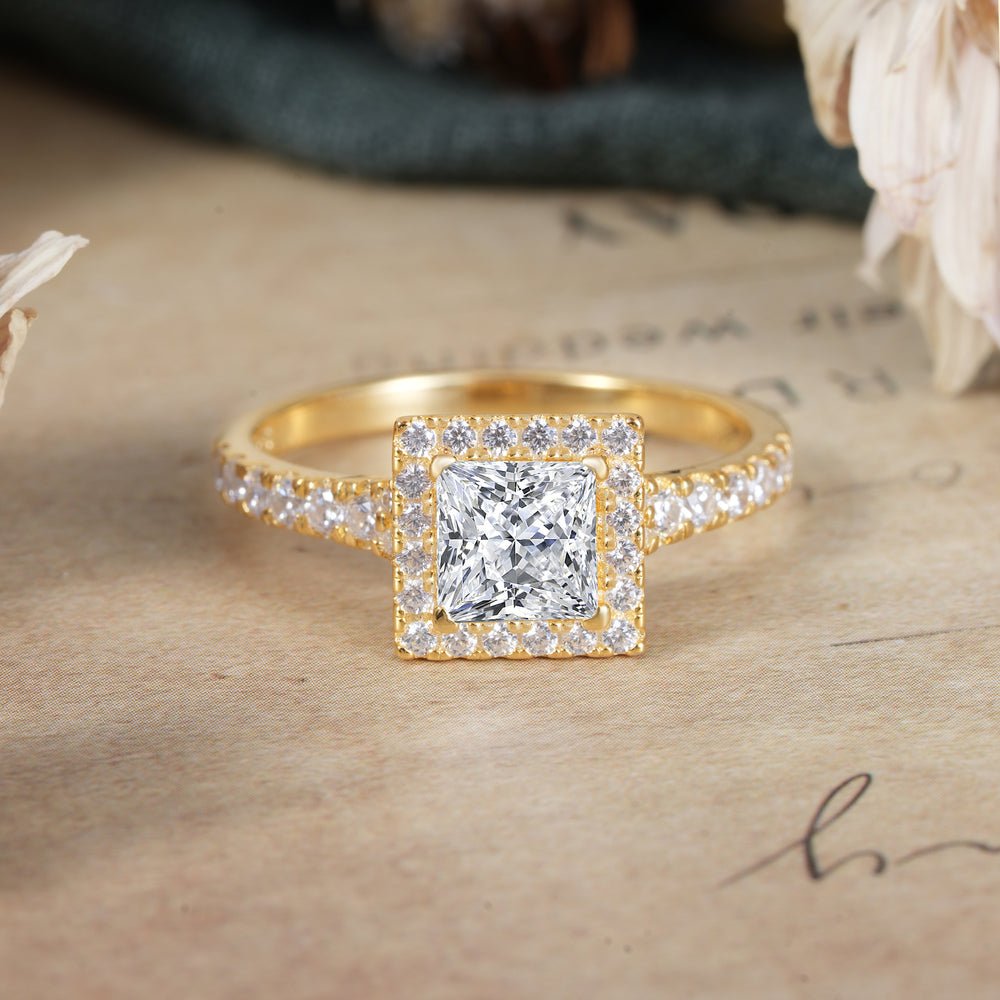
Images: Romalar
Can people tell the difference?
In everyday settings, almost no one can tell a well-cut moissanite from a diamond at arm’s length. Differences show up in specific conditions: in direct sunlight, moissanite’s stronger rainbow flashes are more noticeable, and in very large stones (around 2 carats and up) some people find moissanite looks a little “busier”. A jeweller with a moissanite tester or a loupe can identify it quickly, because moissanite shows double refraction (facet edges appear doubled when viewed through the stone at certain angles) and conducts electricity differently from diamond.
A lab diamond, by contrast, can’t be distinguished from a natural diamond without advanced laboratory equipment. Many lab diamonds over a certain size are laser-inscribed on the girdle so they can be identified as lab-grown, which is a sign of transparency rather than a flaw.
If it matters to you that the stone is “a diamond” in name and chemistry, choose lab-grown. If what matters is how it looks on your hand and what it costs, moissanite is hard to beat.
How to choose between them
- Choose moissanite if you want the largest, most sparkly stone for your budget, you like a bit of rainbow fire, the ring is mainly for wearing (not resale), and you don’t need the word “diamond”.
- Choose a lab-grown diamond if you want a stone that is optically and chemically a diamond, you value standardised grading reports, and you’re comfortable paying more for that.
- Choose a natural diamond if natural origin matters deeply to you or your family, and you accept the much higher price.
- Consider a coloured gemstone such as sapphire, opal or morganite if you’d rather not have a white stone at all. Note that softer stones like opal (around 5.5–6.5 on the Mohs scale) need more care in a ring worn every day.
Reading the specs on a ring listing
| Spec | What it means | What to look for |
|---|---|---|
| Carat (ct) | Weight. For moissanite, often given as a “diamond equivalent” size because moissanite is lighter than diamond for the same dimensions | Compare the millimetre size, not just carat |
| Stone size (mm) | The visible face-up size | The most honest way to compare across stone types |
| Colour | For white stones, D–F is colourless; G–J near-colourless | D–F looks icy white; G–H is a good value balance |
| Clarity | How many internal features are visible under magnification | VS (very slightly included) is usually clean to the eye |
| Cut / shape | Round, oval, princess, emerald, etc. | Round maximises sparkle; oval and elongated shapes look larger per carat |
| Metal | The band material and purity | 14K or 18K gold, platinum, or sterling silver; confirm it in writing |
The setting matters as much as the stone
- Halo settings surround the centre stone with smaller stones, making it look larger and adding sparkle, but small stones can loosen over years and need occasional checks.
- Half-eternity bands (stones across the top half) are more comfortable and easier to resize than full-eternity bands.
- Prongs: four prongs show more of the stone; six prongs hold it more securely. Check them once a year.
- Metal colour: white gold or platinum makes white stones look whiter; yellow and rose gold give a warmer, vintage look and can make a near-colourless stone appear slightly warmer.
Caring for moissanite and lab diamond rings
Both stones are tough, but rings live hard lives. A little care keeps them sparkling:
- Clean weekly at home. Soak in warm water with a drop of mild dish soap for 15–20 minutes, then brush gently behind the stone with a soft toothbrush and rinse. Lotion, soap and skin oils dull sparkle more than anything else.
- Take it off for heavy work. Gym sessions, gardening and moving furniture can bend prongs or scratch the metal, even if the stone itself is fine.
- Avoid harsh chemicals. Chlorine in pools and hot tubs can damage gold alloys over time.
- Store separately. Diamonds and moissanite can scratch other jewellery and softer gemstones. Keep rings in individual soft pouches or compartments.
- Get prongs checked yearly by a local jeweller, especially on halo and pavé settings.
Does moissanite get cloudy?
A common worry is that moissanite turns cloudy or yellow over time. Modern moissanite does not change colour or become cloudy with wear. When a moissanite ring looks dull, it’s almost always a film of oil, soap or lotion, which disappears with cleaning. Older generations of moissanite sometimes had a slight yellow or green tint in certain lighting; today’s colourless grades are much whiter.
Ethics and sustainability: a quick reality check
Both moissanite and lab-grown diamonds avoid mining, which is a major reason people choose them. They still require significant energy to produce, and the environmental footprint depends heavily on the energy source used by the manufacturer. If sustainability is a priority, ask the seller where and how stones are made and whether recycled metal is available. Recycled gold and silver often make a bigger difference to a ring’s footprint than the stone itself.
Buying a made-to-order ring online: what to check
- Metal type and purity. Ask for the exact metal (for example 14K solid gold vs gold-plated silver) if it isn’t stated clearly on the listing.
- Stone certification. Lab diamonds commonly come with an IGI or GIA report; moissanite may come with a brand or third-party certificate that is less standardised.
- Ring size. Get sized professionally, or measure a ring you already wear on the same finger. Wider bands fit tighter, so size up slightly for bands over about 4 mm.
- Production and delivery time. Made-to-order rings take weeks, not days. Plan around proposals and weddings.
- Cancellation, return and resizing policies. Custom pieces often have strict terms. Read them before you pay.
- Customs and taxes. International orders may incur import duties on arrival.
Budgeting tip: put the money where it shows
If you’re working to a budget, spend on the parts people notice. Face-up size and cut quality are visible from across a room; the difference between D and F colour or VS1 and VS2 clarity usually isn’t. With moissanite’s lower price, many buyers choose a slightly larger centre stone or upgrade the metal instead. With lab diamonds, a G or H colour in a well-cut stone often looks just as white as a D once it’s set, especially in yellow or rose gold.
A closer look: Romalar Jewelry
Romalar is an online jeweller that makes rings to order, with a catalogue spanning moissanite, lab diamonds and a wide range of coloured gemstones such as opal, moonstone, moss agate, turquoise, sapphire and emerald. Most designs are offered in yellow, rose or white gold colourways. Its policies state that rings are handcrafted from scratch using gold or silver.
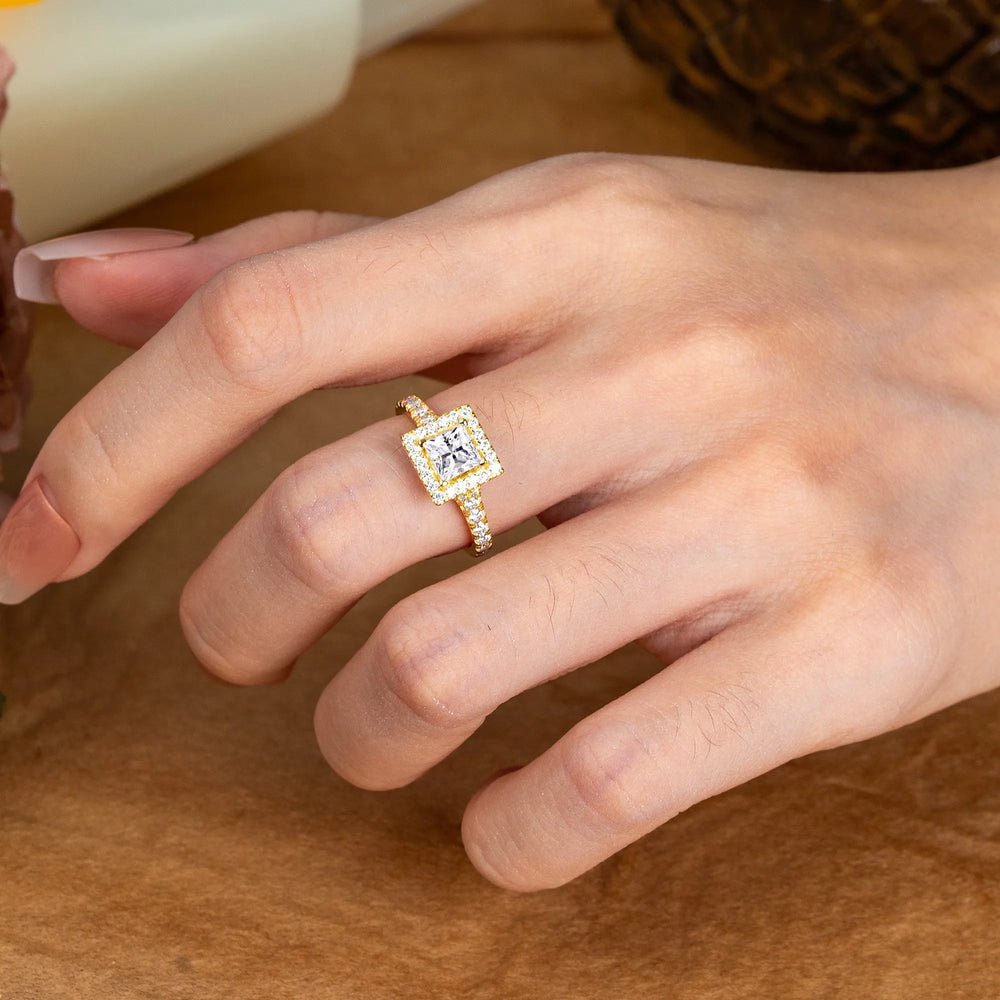
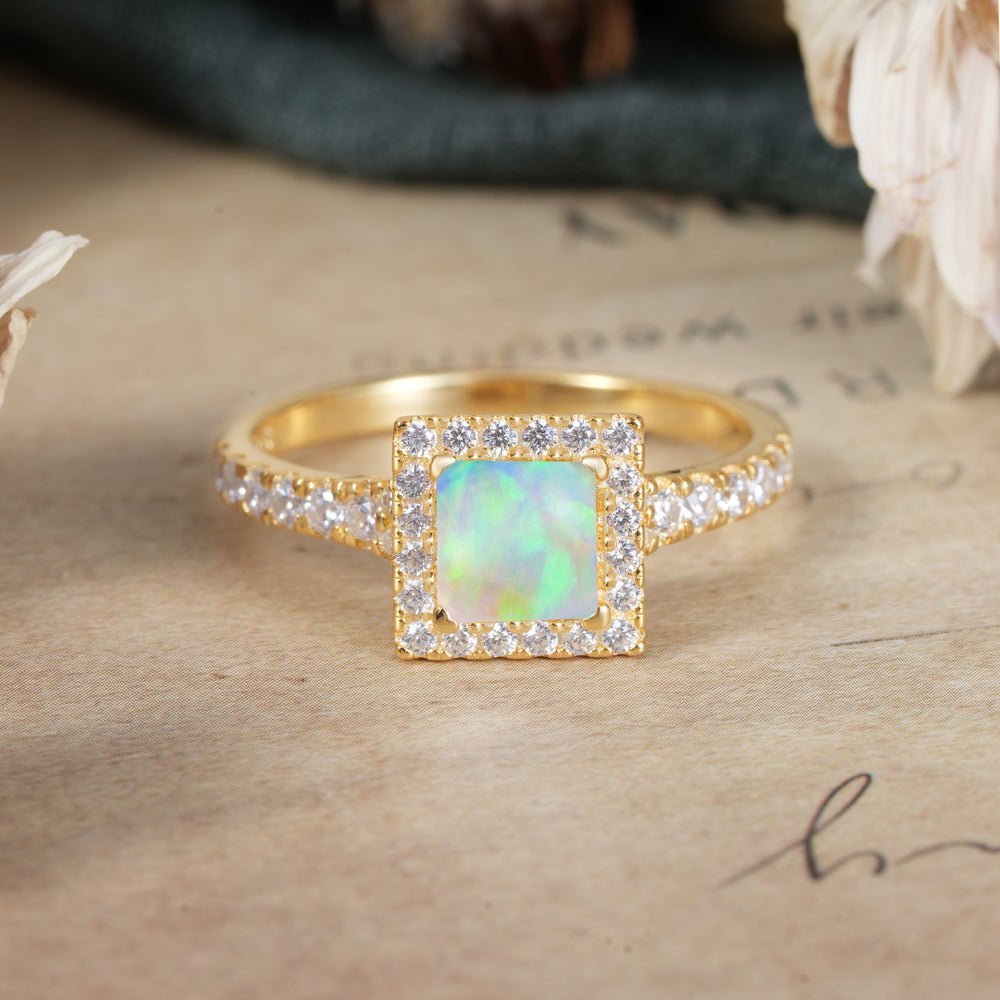
What stands out is the side-by-side pricing: you can often buy the same design with different stones, which makes it easy to compare moissanite, lab diamond and coloured-stone versions directly. As an example of the range, the princess-cut halo design above is also available with an opal centre.
Things to know before ordering
- Timing: Romalar lists 6–8 business days of production plus 5–7 business days of shipping for standard orders, 10–20 business days of production for custom orders, and a faster rush option.
- Cancellations are time-sensitive: according to Romalar’s policy, standard orders can be cancelled free within 8 hours of ordering. After that, once production has started (up to 3 days), cancellation carries a fee equal to 35% of the order, and modifications carry a 20% fee. Double-check size, metal colour and stone before you pay.
- Confirm the metal. Listings show gold colour options; contact the store to confirm the exact metal and purity for the ring you choose.
- Shipping and duties: free shipping on orders over $200; customs duties and taxes are the recipient’s responsibility.
How to buy and save at Romalar
- Use the code HAPPYSAVE at checkout for 20% off. On the moissanite halo ring above, that’s a saving of over $100.
- Compare stone options on the same design before deciding; the price difference between moissanite and lab diamond can be large.
- Order within your free-cancellation window only when you’re sure of size and details.
Enter HAPPYSAVE in the discount field and confirm the 20% reduction on the order summary before paying.
Browse Romalar rings – code HAPPYSAVE for 20% off
Sources (checked 13 November 2026): Romalar product pages for the Princess Cut Moissanite and Lab Diamond Half Eternity Halo rings and Princess Cut Opal ring, including specifications and prices; Romalar cancellation, modification and shipping policies (romalarjewelry.com). Gemstone hardness and optical properties reflect standard gemmological references.