

Disclosure: This guide contains one affiliate link and a discount code. If you buy through them, She Chooses Well may earn a commission at no extra cost to you. This article is general wellbeing information, not medical advice. Prices were checked on the Pure Frequencies store on 13 November 2026 and are in USD.
Most sleep advice is a list of things to stop doing: no screens, no caffeine, no late dinners. Useful, but it leaves a gap. If you take away your phone at 10pm and replace it with nothing, your mind simply fills the silence with tomorrow’s to-do list.
A wind-down routine works better when it’s built, not just subtracted. This guide lays out a 60-minute evening routine based on the sleep habits with the strongest evidence behind them, then shows where calming rituals such as breathing, journaling and sound or vibration fit in, and how to choose the ones you’ll actually keep doing.
Why a routine helps at all
Your body runs on a roughly 24-hour internal clock. Light, temperature, activity and meal timing all nudge it. A consistent evening routine does two things: it removes stimulation that keeps your brain in “day mode”, and it creates repeated cues that your body learns to associate with sleep. The routine doesn’t need to be elaborate. It needs to be consistent and pleasant enough that you’ll do it every night.
The foundations: get these right first
No ritual can outrun these basics. If you only change a few things, change these:
- Keep a steady wake-up time, including weekends. A consistent wake time anchors your body clock more reliably than a fixed bedtime.
- Get daylight in the morning. Bright light early in the day helps set your clock so that you feel sleepy at a sensible time at night.
- Set a caffeine cut-off. Caffeine stays in your system for hours. Many sleep specialists suggest stopping around early afternoon, or at least eight hours before bed if you’re sensitive.
- Keep the bedroom cool, dark and quiet. A slightly cool room is commonly recommended, along with blackout curtains or an eye mask and earplugs if needed.
- Go easy on alcohol near bedtime. It can make you drowsy at first but tends to fragment sleep later in the night.
A 60-minute wind-down routine
60 minutes before bed: lower the lights and put devices away
Switch to lamps or warm, dim lighting. Put your phone on charge outside the bedroom if you can, or at least out of reach. The point isn’t only blue light; it’s that phones are designed to keep you engaged, and engagement is the opposite of winding down. If you read, choose paper or an e-reader without notifications.
45 minutes before bed: empty your head onto paper
Write down everything that’s still buzzing: unfinished tasks, worries, ideas. Then write a short list of what you’ll do tomorrow. Research on bedtime writing suggests that writing a specific to-do list for the next day may help some people fall asleep faster than journaling about what they’ve already done. Either way, the aim is to stop rehearsing tasks in bed.
30 minutes before bed: warm shower or bath
A warm shower or bath in the hour or two before bed is a common recommendation. Warming the skin helps your body shed heat afterwards, and that drop in core temperature is part of how your body prepares for sleep. Change into comfortable, breathable sleepwear.
15 minutes before bed: one calming ritual
This is the part most routines skip and the part people enjoy most. Choose one practice and keep it short. The best ritual is the one you’ll do every night, so pick based on what you find genuinely relaxing, not what sounds most impressive.
Choosing your calming ritual
| Ritual | How to do it | Best for | Evidence |
|---|---|---|---|
| Slow breathing | Breathe in for 4 counts, out for 6, for 5 minutes | Racing heart, anxious thoughts | Good evidence that slow breathing lowers arousal |
| Progressive muscle relaxation | Tense and release each muscle group from feet to face | Physical tension, clenched jaw | Well studied as part of insomnia programmes |
| Gentle stretching | 5–10 minutes of slow floor stretches | Desk workers, tight hips and back | Helpful for relaxation; avoid intense exercise late |
| Body scan or guided audio | Lie down and follow a recording | People who find silence difficult | Mindfulness practices show modest benefits |
| Sound or vibration | Singing bowl, tuning fork or calming audio, used mindfully | People who like a tactile, sensory ritual | Limited research; mainly valued as a focus point for relaxation |
What to do with your phone instead
For most people, the phone is the hardest part of any wind-down routine. Rather than relying on willpower, change the setup: charge the phone in the kitchen or hallway, use a cheap alarm clock instead of your phone alarm, and turn on your phone’s scheduled downtime or focus mode so non-essential notifications stop an hour before bed. If you like listening to something, download a podcast or audiobook in advance and use a sleep timer so the screen stays dark.
Where tuning forks fit in
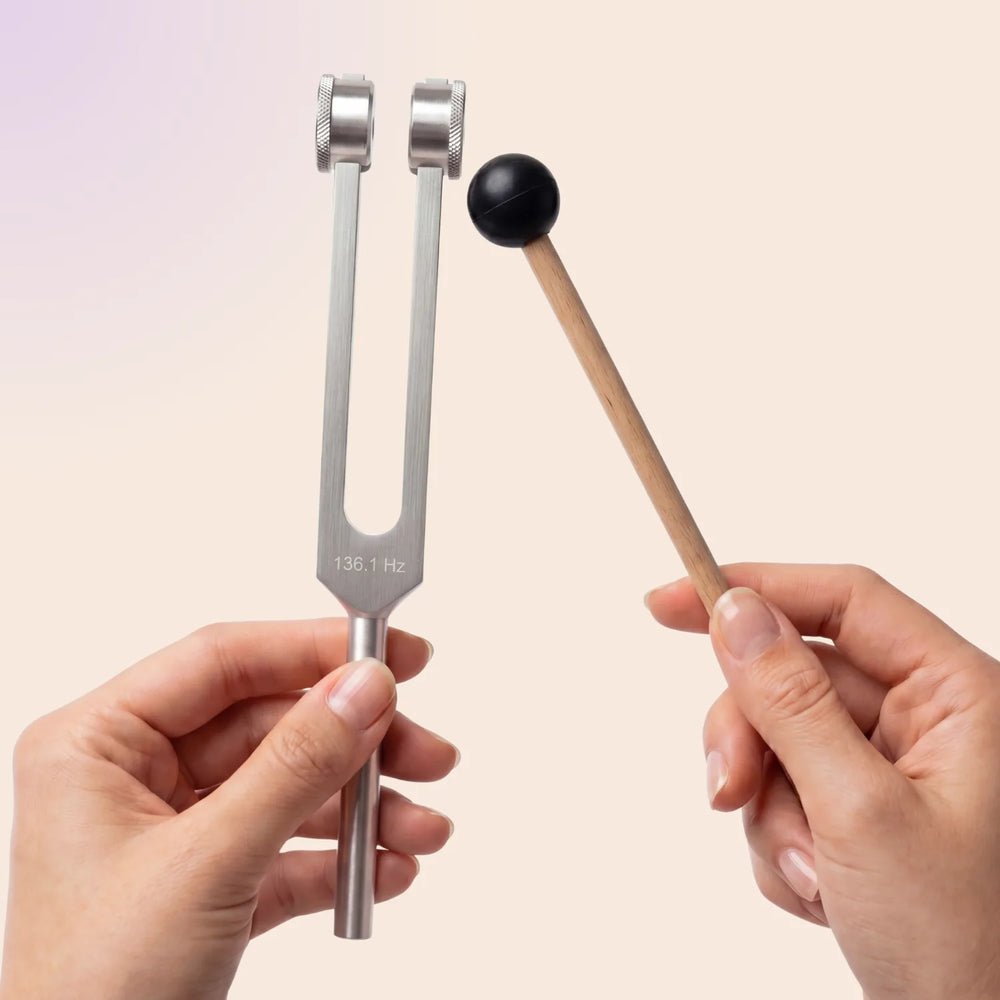
Tuning forks have moved from music rooms into wellness routines. You strike the fork gently, then either hold it near your ears to listen as the tone fades, or place the stem of a weighted fork on the body (for example the sternum, the back of the neck or the soles of the feet) to feel the vibration.
It’s worth being clear about the evidence. Many sound-healing brands make strong claims about specific frequencies affecting the nervous system, emotions or healing. These claims have not been established by robust clinical research. What a tuning fork can offer is simpler and still valuable: a short, sensory, repeatable ritual that pulls your attention into the present moment. Listening to a tone until it disappears is a natural cue to slow your breath. For people who struggle with traditional meditation, having something physical to focus on can make the practice easier to stick with.
A five-minute tuning fork ritual for bedtime
- Sit or lie comfortably with the lights low.
- Strike the fork gently against a soft surface or with the mallet.
- Hold it a few centimetres from one ear and listen until you can’t hear the tone. Breathe out slowly as it fades.
- Repeat on the other side. Do three to five rounds.
- If you have a weighted fork, place the stem lightly on the centre of your chest or the soles of your feet and notice the vibration.
- Finish with five slow breaths and go to bed.
Avoid placing a vibrating fork directly on injuries, over a pacemaker or on the abdomen during pregnancy, and stop if anything feels uncomfortable.
Five wind-down mistakes that undo the good work
- Making the routine too long. A 90-minute ritual that you abandon after four nights is worse than a 20-minute one you keep. Start with two steps and add more only if you want to.
- Doing it at a different time every night. The cue only works if it’s predictable. Anchor the routine to a fixed time, not to “when I finish everything”.
- Using the bed for everything. Working, scrolling and eating in bed weakens the link between bed and sleep. Do your ritual in a chair or on the floor, then get into bed to sleep.
- Clock-watching. Checking the time when you can’t sleep adds pressure. Turn the clock away from you.
- Lying awake for ages. If you’ve been awake for what feels like 20 minutes, get up, do something quiet in dim light and return when you feel sleepy. This is a core part of CBT-I.
Making the routine stick
Habits stick when they are easy, attached to something you already do, and satisfying. A few practical ways to apply that:
- Stack it. Attach the routine to a fixed cue you never skip, such as brushing your teeth or setting your alarm.
- Prepare the space in the morning. Leave your notebook, book or tuning fork on the bedside table so there’s nothing to set up at night.
- Keep a two-week log. Note when you started the routine, roughly when you fell asleep and how you felt the next day. Patterns are easier to see on paper than in memory.
- Plan for disrupted nights. Travel, late events and sick children happen. Have a five-minute “minimum version” (for example, dim lights plus five slow breaths) so the habit survives busy weeks.
If you share a bed or a home
A partner with a different schedule, a bright hallway or children who wake at night can make a routine harder. Small fixes help: an eye mask and earplugs for different bedtimes, a dim night light instead of the main light for night wake-ups, and doing your calming ritual in another room if your partner is still reading. If snoring keeps you awake, encourage your partner to mention it to a doctor, since loud snoring can be a sign of sleep apnoea.
When it’s more than a routine problem
A routine helps most people, but it isn’t a treatment. Talk to a doctor if you regularly take more than about 30 minutes to fall asleep, wake often and can’t get back to sleep, snore loudly or stop breathing in your sleep, or feel exhausted during the day despite enough time in bed. Cognitive behavioural therapy for insomnia (CBT-I) is the recommended first-line treatment for chronic insomnia and is available through clinicians and structured online programmes.
Pure Frequencies: tuning forks for a bedtime ritual
If you want to try a tuning fork as your calming ritual, Pure Frequencies is one brand that sells weighted and unweighted forks, sets and accessories aimed at home use. Its product descriptions make a number of bold claims about specific frequencies; as above, we’d treat those as the brand’s own descriptions rather than proven effects, and choose based on the ritual you want.
| Product | What it is | Price (USD) |
|---|---|---|
| 136.1 Hz “Earth OM” Fork | Single weighted fork; Pure Frequencies positions it for calming and meditation | $39.95 |
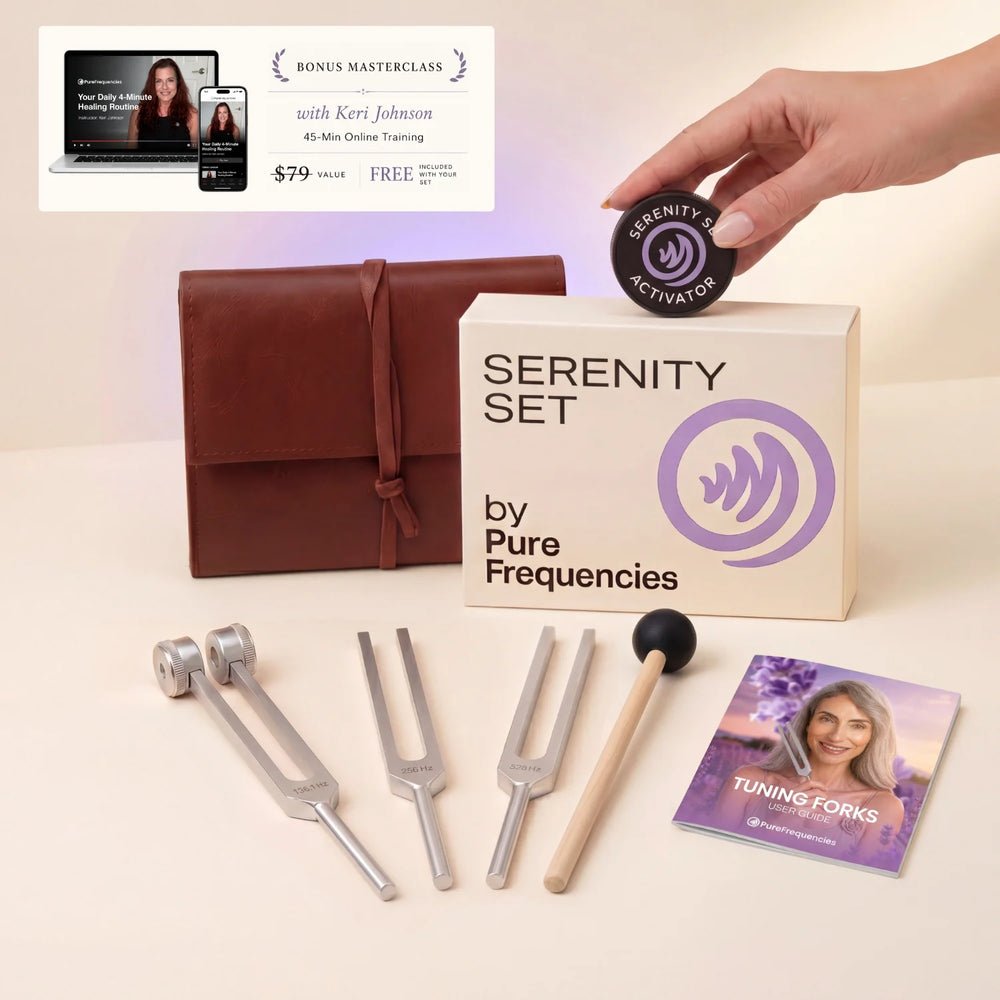
| Serenity Tuning Fork Set | Three forks (136.1 Hz, 528 Hz, 256 Hz); the brand describes it as its set for sleep and stress | $79.95 (listed down from $109.85) |
| Harmony Tuning Fork Set | The brand’s larger set | $109.95 (listed down from $149.80) |
| Guided Tuning Fork Rituals | Digital guide to routines | $9.95 |
| Harmony Acupressure Mat | Spiked mat for lying on during relaxation | $74.00 |
How we’d choose: if you’re new to this, a single weighted fork is enough to find out whether the ritual suits you. The Serenity Set makes more sense if you already know you enjoy it and want variety. There’s no need to buy accessories until you’ve used the fork for a few weeks.
How to buy and save at Pure Frequencies
- Use the code THANKYOU at checkout for 10% off.
- Start small. One fork at $39.95 is the lowest-risk way to test the ritual.
- Check set pricing. When we checked, the Serenity and Harmony sets were listed below their combined individual prices.
Enter THANKYOU in the discount field and confirm the reduced total before you pay.
Shop Pure Frequencies – code THANKYOU for 10% off
Whatever ritual you choose, give it two weeks of nightly practice before judging it. Sleep routines work through repetition, not novelty.
Sources (checked 13 November 2026): Pure Frequencies product pages and pricing (purefrequencies.com). General sleep guidance reflects widely published recommendations from sleep medicine organisations, including the American Academy of Sleep Medicine’s recommendation of CBT-I as first-line treatment for chronic insomnia, and published research on bedtime to-do list writing and slow-paced breathing.